Access Is Free. Judgment Is Not. The Real Cost of AI Is Pointing It at the Wrong Work

Mahdi Salmanzade
Co-Founder & CTO of CLRT
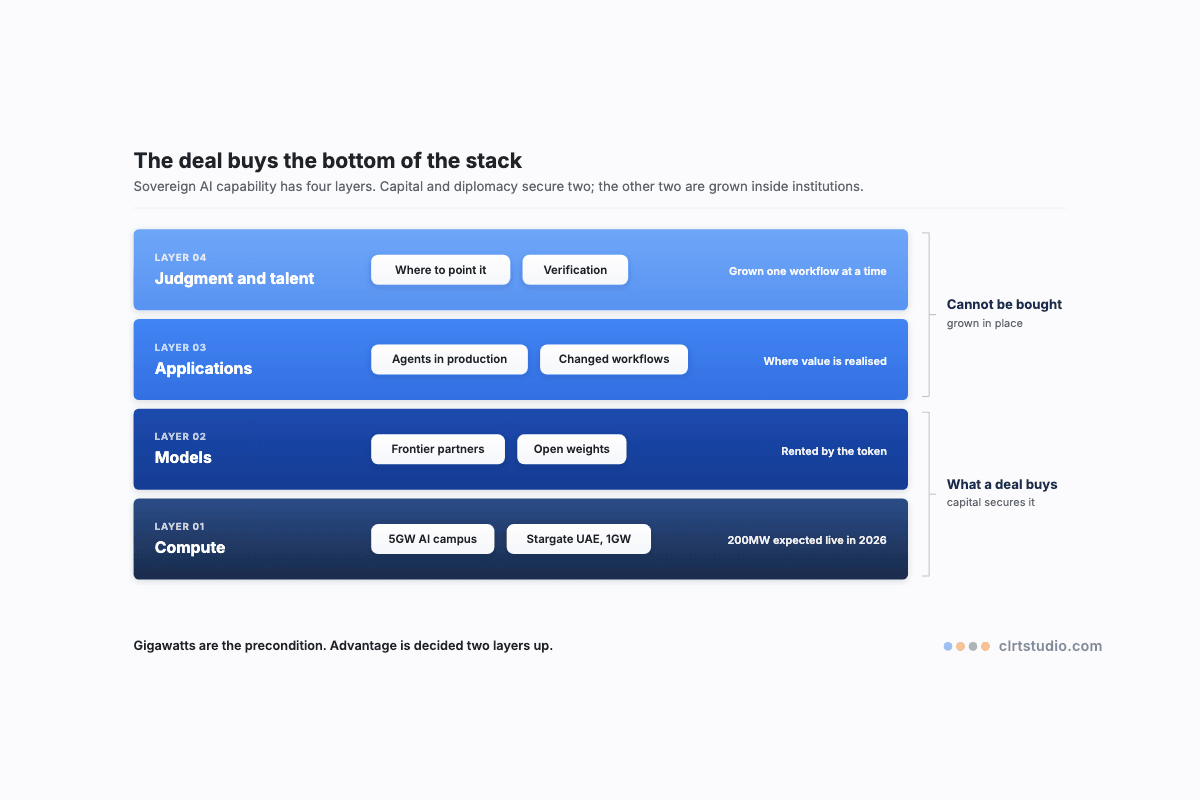
Spend an afternoon and you can wire up frontier-class models for nothing. Free tiers, trial credits, startup programs, student packs, edge inference, open weights routed through a single key. The supply is embarrassing. And that abundance is the most important signal in the market, because it proves the thing everyone is still paying to protect is no longer scarce. The model is a commodity. What remains scarce, and getting scarcer, is knowing where to point it and making it trustworthy once you do.
Most people read the flood of cheap access as a saving. It is closer to a trap. When intelligence is almost free, the entire cost of an AI initiative migrates somewhere the invoice never shows it: into the choice of what to automate, and into the engineering that makes the automation safe to rely on. A team that fixates on the twenty dollars a seat is optimising the one line of the budget that rounds to nothing, while ignoring the two lines that decide whether the project returns anything at all. The price tag is a decoy. It draws the eye away from the real spend.
Consider what cheap access actually changes and what it leaves untouched. It removes the barrier to running a model. It does nothing to tell you which workflow, of the hundreds inside a business, is the one where an agent compounds value rather than quietly manufacturing plausible errors at scale. A capable model aimed at the wrong process does not fail loudly. It produces confident, well-formatted output that is subtly wrong, and because it was free to run, nobody counts the cost of the rework, the eroded trust, or the decision made on a fabricated number. The cheaper the model, the easier it is to deploy it somewhere it should never have been pointed.
Then there is the second half, the part the abundance hides completely. A model that answers is not a system you can run a business on. Getting from a clever demo to something that holds up in production is the hard, unglamorous work: grounding the model so it stops inventing, constraining its outputs so they are checkable, building the maker-and-checker separation so one part of the system audits another, instrumenting it so failures surface before a customer finds them. None of that comes with the free tier. The free tier gives you the easy ninety percent that impresses in a meeting and none of the final ten percent that determines whether you can trust it at nine in the morning when it acts unattended.
This is why the question that matters is never which model, or how to get it cheaply. Those are solved problems, and the market has solved them so thoroughly that the answer is now free. The unsolved problem is judgment: of the work a business actually does, where does autonomous intelligence create leverage instead of liability, and how do you engineer it so the leverage is real and the liability is contained. That judgment does not arrive with an API key. It is the accumulated pattern-recognition of having pointed these systems at real workflows and watched which ones paid and which ones quietly cost more than they saved.
Access being free is the proof, not the prize. It removes the last excuse to confuse having the tool with knowing what to do with it. Every competitor has the same models now, at the same price of nothing. The advantage has moved entirely to the layer above the model, to the firms that know where to aim it and how to make it dependable, and away from the firms still congratulating themselves on the subscription they avoided.
When the model costs nothing, the entire cost of being wrong moves to where you pointed it.
A deeper dive
The traps are specific, and they are the kind you only see after you have been burned by them. A model that is cheap and fast tempts you to put it in the loop everywhere, but latency and price are the wrong axes once access is free; the axis that matters is the cost of a confident mistake in that particular workflow, and it ranges from trivial to catastrophic across tasks that look identical from the outside. Drafting an internal summary and authorising a payment can run on the same model and the same prompt, yet one tolerates error and the other cannot, and nothing in the free tier tells you which is which. Retrieval that looks grounded still hallucinates at the seams. An agent that passes every test you wrote fails on the input you did not imagine. Open-weight routing that saves money on volume silently swaps the model underneath you, so the behaviour you validated last month is not the behaviour running today. Each of these is invisible until production, and each is a judgment call about where the model belongs and how tightly it must be constrained, not a feature you can buy.
So the real engineering is not access, it is trust. Making a model trustworthy in production means deciding what it is allowed to act on alone and what it must escalate, building the checks that catch its errors before a human or a customer does, grounding it against your own systems of record so it cannot drift into fiction, and instrumenting the whole thing so that when it does fail, and it will, you find out first. This is the work that does not appear in any guide to free credits, because it cannot be downloaded. It is designed, for your business, against your actual risk surface. The firms that win the next few years are not the ones with the best access. Everyone has that. They are the ones who turned a commodity model into a system they could stake a decision on, and that is a capability, not a subscription.
Work with CLRT
Anyone can run the model now. The work that pays is knowing which of your workflows deserves it and building the system that makes its output safe to trust. That is the discipline CLRT exists for: not access, which is free, but judgment about where to point AI and the engineering to make it dependable in production. Bring us the work you were about to automate, and we will tell you where the real cost is hiding and build the version you can rely on.

Mahdi Salmanzade
Mahdi Salmanzade is the Co-Founder and CTO of CLRT, where he builds agentic systems, developer tools, local-first AI, and security-first infrastructure. Reach him at mahdi@clrtstudio.com or on LinkedIn.