Agentic AI for the Solopreneur

Vishal Sachar
Co-Founder & CEO of CLRT
Most solopreneurs are about to use AI to make the wrong thing faster. They will point it at their own tasks and become a quicker, more caffeinated version of a one-person band, still the bottleneck, still doing everything, just at higher speed. That is the trap, and avoiding it is the whole game. AI's gift to the solopreneur is not that you can work faster. It is that one person can finally be a company, if you stop using it to do more yourself and start using it to build the systems that do the work without you.
The solopreneur's limit was never talent or ideas. It was arithmetic. You are one person, and everything routes through you, so the business can only ever be as large as your own hours. AI changes that arithmetic for the first time, not by making you faster, but by giving you something a solopreneur has never had: staff. An agent that handles your inbound enquiries, another that follows up with every lead without tiring, another that drafts your content, another that chases your invoices. These are your first hires, and they do not need managing in the way people do.
This is the same distinction that separates a struggling founder from a scaling one. A founder who personally does every task is, in the language of these systems, prompting, holding the tool through every action. A founder who designs systems that run on their own and step in only to approve and decide has become the loop, with the agents as steps inside it. For a solopreneur that shift is not a productivity tip. It is the difference between owning a job and owning a business.
The discipline it demands is counterintuitive, because it means doing less of the work yourself even when you could do it well. Every task you keep because you are good at it is a task that keeps the business chained to your hours.
Stop using AI to become a faster one-person band. Use it to stop being one.
A deeper dive
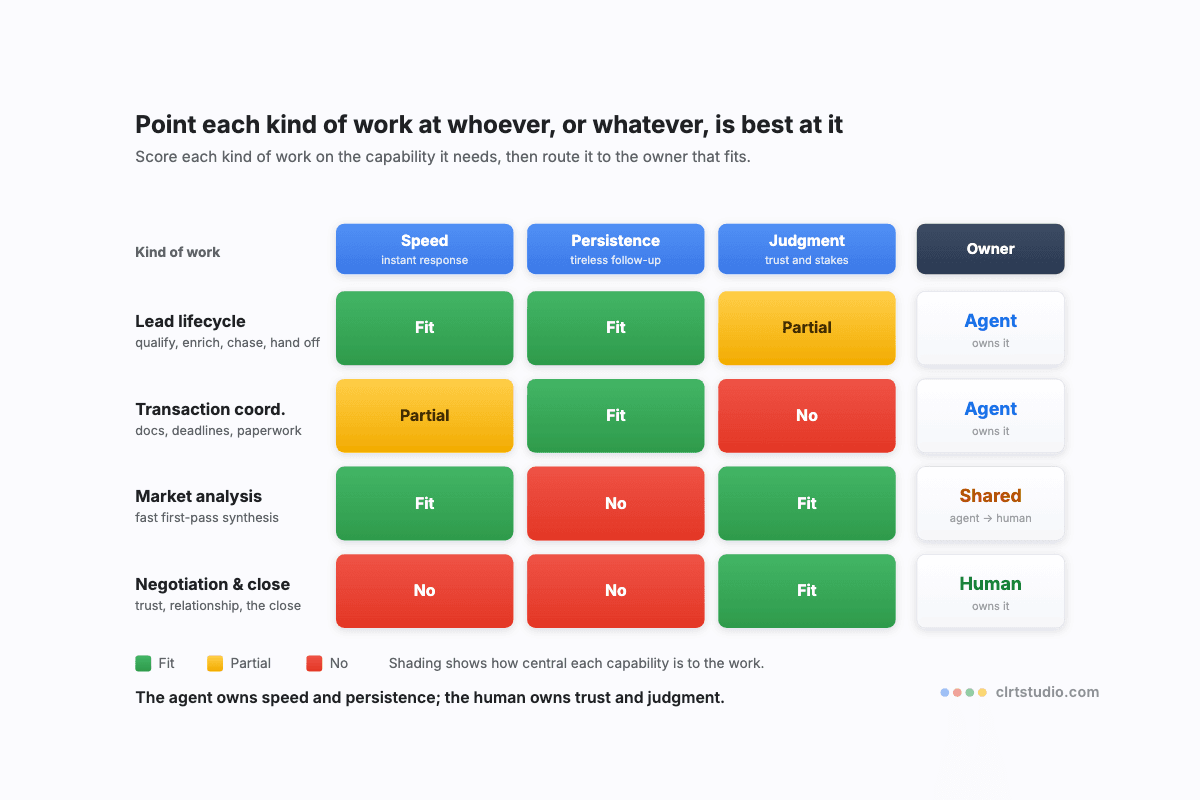
The practical path starts where the cornerstone leaves off: map your week to the recurring job-shapes, the framework in The Ten Jobs an AI Agent Is Actually Good At, find the one eating the most of your time, and build there first. The thing that makes a solo agent stack reliable rather than chaotic is writing down how you do things, your tone, your rules, your process, as instructions the agents follow, so they act like you instead of guessing, and so your way of working compounds instead of resetting every session. Even solo, you keep the maker-and-checker discipline on anything that matters, never letting an agent send the high-stakes thing unseen, because a one-person business cannot absorb a confident, fluent mistake, the warning in Where AI Almost Works Is Where It Hurts You. The progression to aim for is the one that takes you from "AI does my tasks" to "AI runs my processes and I approve the decisions," which is the personal-scale version of building a company that runs on a layer of agents, the subject of Building a Company of Agents. Done with judgment, this is how one person builds leverage that used to require a payroll.
Work with CLRT
One person can now run what used to take a team, but only if you build systems instead of just working faster. CLRT helps solo founders turn their repetitive work into agents and become the loop rather than the bottleneck. Let us find your first hire.

Vishal Sachar
Vishal Sachar is the Co-Founder and CEO of CLRT, where he helps UAE businesses make sense of applied agentic AI and put it to work. He writes on agentic systems, AI governance, and the economics of automation. Reach him at vishal@clrtstudio.com or on LinkedIn.