Organizational Memory Is Not a Folder You Point AI At

Mahdi Salmanzade
Co-Founder & CTO of CLRT
The pitch is seductive and almost true. Give your AI access to everything the company knows, and it stops starting from zero. No more re-explaining the strategy, the history, the decisions, the constraints. The agent simply knows. At the scale of one disciplined individual, this works, because that person is the sole author and the sole arbiter of what is true. At the scale of an organization the same idea quietly inverts. Your context is not sitting in a folder waiting to be indexed. It is scattered across contradictory documents, locked inside people's heads, spread over systems that disagree with each other, and layered with decisions whose reasoning was never written down. Point an agent at that and you do not get memory. You get a confident narrator of whichever document happened to be loudest.
Start with the word everyone uses loosely. Memory is not retrieval. What most teams actually build when they connect AI to their knowledge is a search index, a system that finds the document most similar to your question and hands it back with conviction. That is useful for lookup and useless as institutional memory, because the thing a company most needs to remember is not its documents. It is its decisions, the reasons behind them, the options it tried and abandoned, and who holds the authority to overrule any of it. Almost none of that exists in a retrievable form. It lives in the gap between what was written and what was meant, and an index cannot see that gap. It can only return the nearest text and trust that nearness is the same as truth.
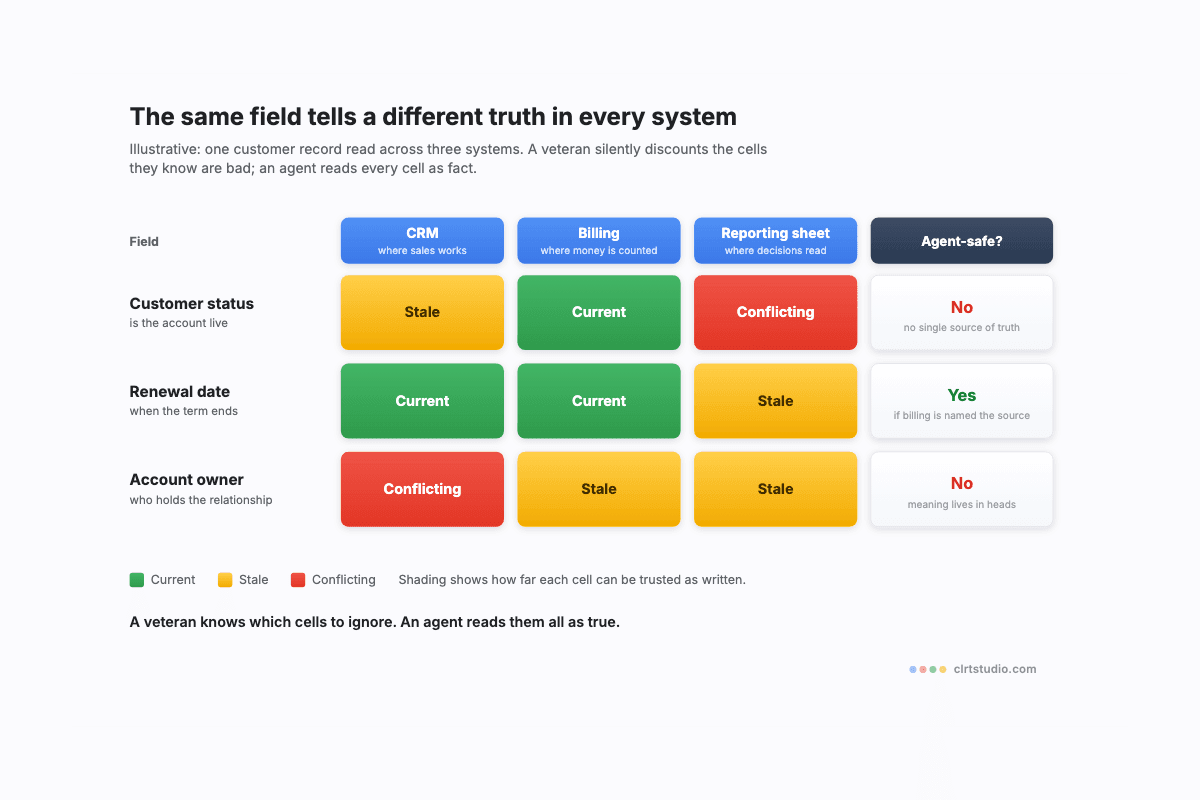
This is where the real difficulty begins, and it is the part the demos never show. Organizational knowledge contradicts itself constantly. The pricing deck says one thing, the contract says another, the thread where the actual decision was made says a third, and all three are sincerely held by different people. A naive system resolves this by accident, surfacing the most recent file, the most frequently referenced one, or the one that happened to embed most cleanly, and it presents that accident as fact. It carries no sense of provenance, no record of which claim superseded which, no notion that a true statement from eighteen months ago is now false. Memory without provenance and without decay is not memory. It is a museum of every version of the truth, displayed without labels.
This is also why the in-house version almost always disappoints. The demo is genuinely easy, an afternoon of wiring, and that ease is precisely the trap, because it sets the expectation that the rest is just more wiring. It is not. The distance between an agent that can answer a question from your files and a system the business can trust to inform a real decision is enormous, and almost all of it is invisible at the demo stage. It is the work of deciding what should count as institutional truth, who is allowed to write it, how a claim earns its place and how it loses it, and how the system behaves when its sources disagree. None of that is a feature you install. It is judgment, encoded and maintained, and it is exactly the part a plugin cannot give you.
The risk compounds the moment the agent can write as well as read, which is the whole point of the appealing version. An agent with write access to the company's memory will eventually write something wrong, and unlike a person who errs in one conversation, it errs into the shared record that everyone else then queries. A single confidently mistaken entry does not stay contained. It becomes the answer that the next ten people, and the next ten agents, build on. At that point the failure is not a bad output. It is corrupted institutional memory, propagating at machine speed, with no one quite sure when the truth changed. Governing that, scoped authority over what can be written, separation between the system that proposes a memory and the system that verifies it, an explicit policy for how knowledge expires, is not an optional refinement. It is the difference between an asset and a liability.
So the scarce skill was never access to the model, and it was never the storage. Anyone can connect AI to a pile of documents, and that is exactly why doing so is worth so little. The scarce skill is the judgment about what in your organization deserves to be remembered as true, and the engineering to keep that memory trustworthy as the organization changes underneath it. Anyone can use AI. The hard, valuable, defensible thing is knowing where to point it, and building the discipline that makes what it remembers worth believing.
An organization does not have a memory problem. It has a truth problem, and pointing AI at the mess only industrializes the mess.
A deeper dive
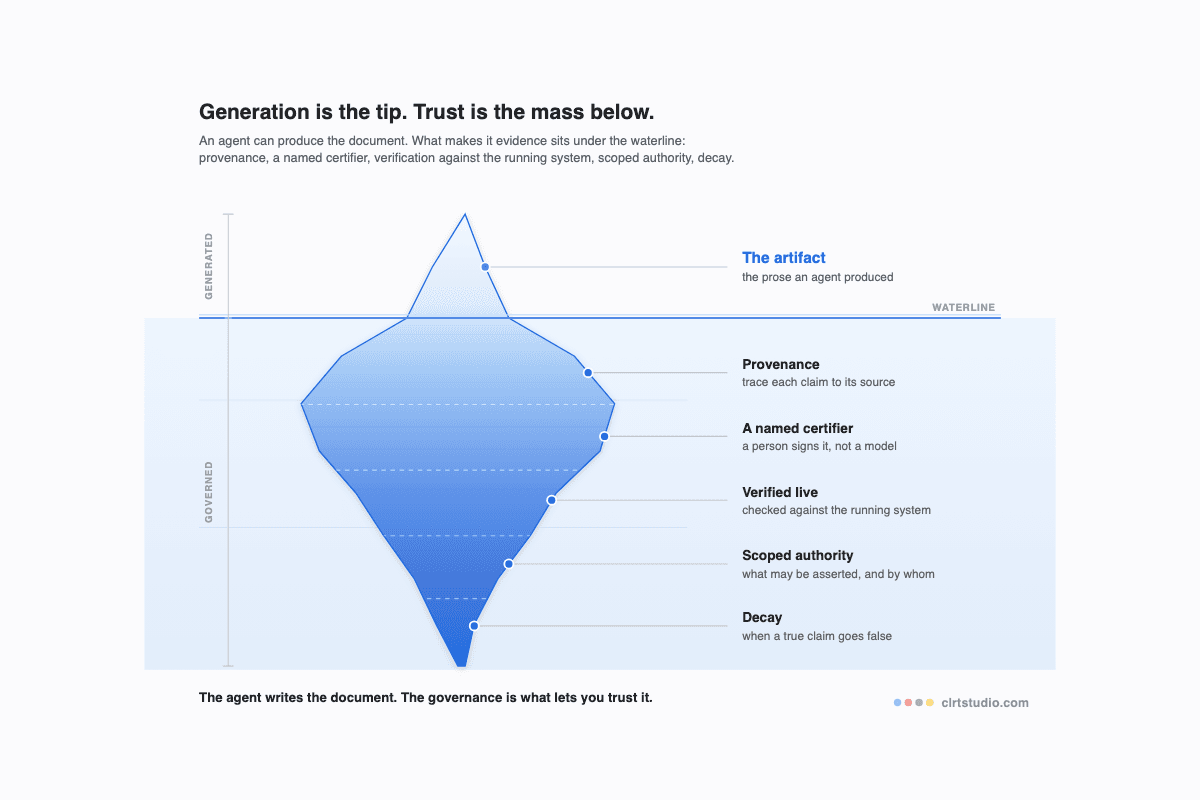
The traps that separate a working system from a merely convincing one are second-order, and they are where most attention should go and almost none does. Contradiction resolution is the first: a real memory system needs an explicit policy for what wins when two sources disagree, and that policy is a business decision disguised as an engineering one, because it encodes who in the company holds authority over which kind of truth. Provenance is the second: every remembered claim has to carry its lineage, where it came from, what it replaced, and when, so that an answer can be challenged and traced rather than merely trusted. Decay is the third: knowledge has a half-life, and a system that cannot tell a durable fact from a perishable one will serve last quarter's reality with this quarter's confidence. The fourth, and the one teams resist most, is the separation of maker and checker: the component that writes a memory must never be the same one that certifies it, because a system that grades its own recall will always believe itself, and a confident wrong answer is far more expensive than an honest admission of not knowing.
This is the angle we take into agentic adoption that almost no one else does. The market is racing to give agents more reach, more tools, more access, on the assumption that capability is the constraint. It is not. The constraint is trust, and trust is earned through provenance, scoped authority, verification, and decay, the unglamorous architecture that decides what an agent is allowed to know, to write, and to be believed about. We treat organizational memory as an engineered and governed system rather than a vault you dump context into, because the version that dumps context into a vault is the version that fails quietly, right up until the day a decision is made on a confidently remembered falsehood. The point of pointing AI at your knowledge was never to make the model sound informed. It was to make the organization decide better, and that only happens when what the system remembers can actually be trusted.
Work with CLRT
If your organization's context is scattered across people, systems, and contradictions, the answer is not another tool pointed at the pile. It is a memory that knows what is true, where each claim came from, and when to stop believing it. That is the work CLRT does, the judgment about where to point AI and the engineering that makes what it remembers trustworthy in production. Talk to us before you industrialize the mess.

Mahdi Salmanzade
Mahdi Salmanzade is the Co-Founder and CTO of CLRT, where he builds agentic systems, developer tools, local-first AI, and security-first infrastructure. Reach him at mahdi@clrtstudio.com or on LinkedIn.