The Agentic Mandate

Vishal Sachar
Co-Founder & CEO of CLRT
Dubai is the first economy on earth where adopting agentic AI is a government directive with a deadline, not a market trend. That single fact reorders every priority for a business operating here.
On 4 May 2026, under the directives of HH Sheikh Mohammed bin Rashid Al Maktoum, HH Sheikh Hamdan bin Mohammed, Crown Prince of Dubai, launched an initiative to transition Dubai's private sector toward agentic AI within two years, with the stated goal of making Dubai the world's leading city in adopting these technologies economically and commercially. The executive plan is specific in a way trends never are. It targets empowering 295,000 companies, developing and delivering 100 specialised AI assistants over two years, and supporting the establishment of 50 agentic AI companies.
The numbers are the message. A trend invites you to wait and see. A target of 295,000 companies inside a two-year window does the opposite. It sets a clock.
What makes this more than an announcement is who has been tasked with delivery. Dubai Chamber of Commerce is directed to build specialised training tracks across its affiliated business councils, to incubate agentic AI companies, and to stand up dedicated funds. The mandate is not a speech. It is an instruction with named owners and a budget behind it.
For a business in Dubai, this changes the question. It is no longer whether agentic AI is relevant to you. The relevance has been decided at the level of the state. The only open question is whether your organisation will be among the companies that crossed the gap, or among those still explaining why they did not.
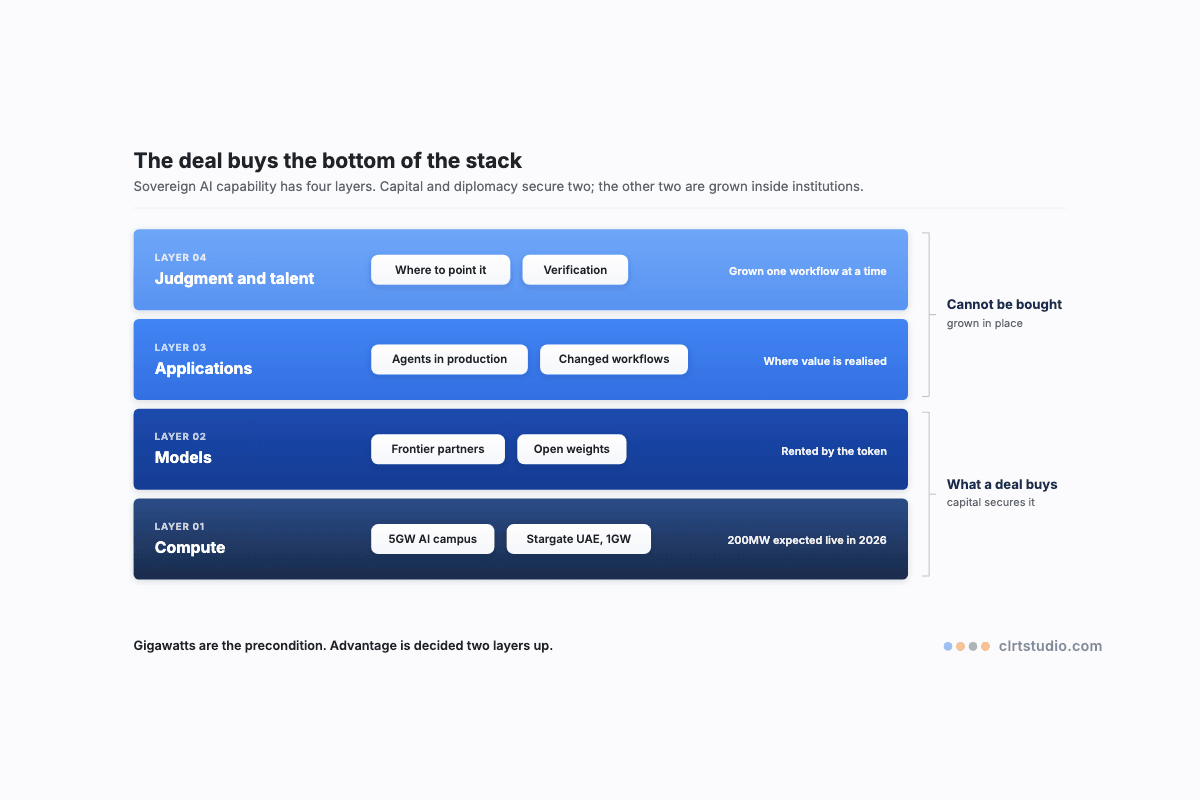
A mandate creates obligation. It does not create capability. Everything that matters now lives in the distance between the two.
A deeper dive
[Author note: During the period of this announcement I was working inside Dubai Chambers' Business Growth function, where the practical job of helping member companies become AI-ready was already underway. So the gap between a directive and a company's ability to act on it is not theoretical to me. I watched it up close, across hundreds of SMEs.]
The architecture of the mandate is worth reading closely, because it tells you how it will actually land. The programme decomposes into three numbers that do different jobs. The 295,000 companies are the demand side, the population that now needs capability. The 100 specialised AI assistants are the supply side, productised agents built for common functions so that not every company has to build from scratch. The 50 new agentic AI companies are the ecosystem play, the supplier base meant to deliver the rest. Dubai Chamber of Commerce holds three instruments to drive it: training tracks routed through the business councils, incubators to seed the supplier base, and dedicated funds to underwrite both. The design is deliberately self-reinforcing. The weak point is the middle. Productised assistants and trained councils still leave each individual company facing the hardest question themselves, which is not what AI is, but where in their specific business it belongs.
Work with CLRT
The mandate sets the obligation. Crossing the gap is a capability problem. That crossing is the work CLRT does with Dubai businesses, and it starts with a conversation about your highest-cost workflow.

Vishal Sachar
Vishal Sachar is the Co-Founder and CEO of CLRT, where he helps UAE businesses make sense of applied agentic AI and put it to work. He writes on agentic systems, AI governance, and the economics of automation. Reach him at vishal@clrtstudio.com or on LinkedIn.