The Week Is the Diagnostic

Vishal Sachar
Co-Founder & CEO of CLRT
The only gold-standard audit of how business leaders spend their time was published in 2018. Michael Porter and Nitin Nohria had the executive assistants of 27 chief executives, running firms averaging over 13 billion dollars in revenue, log their bosses' time in 15-minute increments for 13 weeks, roughly 60,000 hours of data. The headline findings: a 62.5-hour week, with 72% of work time spent in meetings. The quieter finding is the one that should bother you. Nobody has run a comparable study since. Most leaders instrument their ad spend to the dirham and their own week not at all.
Sit with what that study required. Not a survey, because people misremember their own weeks in predictable and flattering ways. Trained assistants coding every 15-minute block, around the clock, for a quarter of a year, across 27 of the most expensive calendars in the world. That is what it takes to know, rather than feel, where leadership time goes. And the result was not flattering: about 37 meetings a week consuming 72% of work time, another 24% on electronic communications, and more than a third of all hours spent reacting to issues the CEO had not chosen. The study won awards, was read everywhere, and changed the behaviour of almost nobody, because knowing the average tells you nothing about your own week. The measurement problem it solved for 27 people remains unsolved for everyone else.
The broader numbers say the drain is not a CEO peculiarity. Deloitte's 2025 Global Human Capital Trends survey, nearly 10,000 leaders across 93 countries, has workers reporting that 41% of their daily time goes to work that creates no value for their organisation. Atlassian's research across 12,000 knowledge workers puts a quarter of the working week into simply searching for information. Both are self-reported, which matters: people confess the drain in general terms far more readily than they surrender the specific hours that make it up. An organisation full of people who agree that 41% of time is wasted will still defend every individual meeting on the calendar. The drain is real, agreed upon, and hiding in plain sight inside ordinary weeks.
Every serious diagnostic method begins by committing to a unit of analysis. Epidemiology has the cohort. Accounting has the transaction. Most AI-readiness exercises choose the organisation, which sounds rigorous and is actually evasive: score an enterprise on a maturity matrix and you get an average, and averages are where evidence goes to die. The right unit for agentic AI is the smallest one that still contains the whole problem: one person, one workflow, one representative week. A week is bounded. A week is checkable against artefacts, the calendar, the inbox, the ticket queue. A week repeats, so one honest week generalises in a way a snapshot survey never can. And, as we argued in Return on Energy, the week is the ledger through which a leader's scarcest input is actually spent, which makes it the one document worth auditing before any tool is chosen.
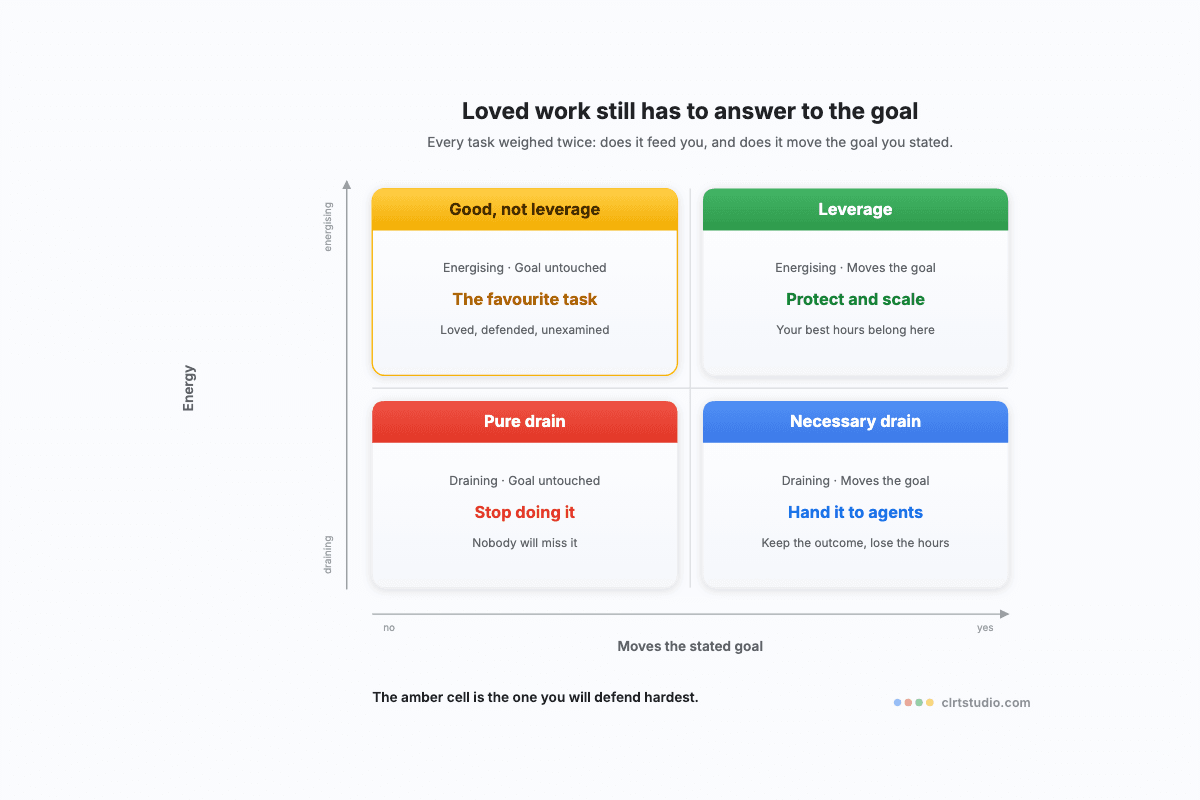
Which is why the audit is harder than it sounds. People defend their calendars the way they defend their habits, because that is what a calendar is: a habit with invitations attached. Every standing meeting has a story, every reporting ritual an owner, and the person who built the week is the least qualified witness to it. Ask someone to tag their own hours against their stated goal and the justification arrives before the evidence does. That is not a character flaw; it is how habit works. It is also why the useful audit is mildly adversarial: the evidence has to be interrogated against the goal, not narrated by the person who created it. Done honestly, something interesting happens near the end. You do not have to choose which workflow to fix. The drain clusters, the clusters have a name, and the workflow names itself.
Leaders instrument their ad spend to the dirham and their own week not at all.
A deeper dive
The methodological point is worth making precisely, because it is where most diagnostics quietly cheat. Self-report and observation diverge in a known direction: time logged as it happens consistently shows less deep work and more coordination overhead than the same people estimate in retrospect, which is why Porter and Nohria used assistants and 15-minute increments rather than asking CEOs to recall their weeks. It follows that Deloitte's 41%, a figure people were willing to admit to, is best read as a floor rather than a ceiling. It also follows that any diagnostic built purely on what a person says about their own week inherits the flattery built into memory. The corrective is not more questions; it is artefacts. A calendar export, a sent-items folder, a ticket history: these do not misremember. The audit that matters reads the artefacts of one representative week against the goal the person actually stated, tags each recurring block as work only this person can do or work a well-built agent could carry, and prices the second pile at the person's loaded cost. The arithmetic is simple. The discipline of doing it without letting the owner of the calendar negotiate each entry is not, and that discipline is the entire difference between a diagnostic and a mirror.
There is also a reason the unit stays small even when the organisation is large. Workflows are fractal in the discouraging sense: a company of 200 people does not have one drain, it has 200 differently shaped ones, and the instinct to survey them all at once produces exactly the maturity-matrix slideware the market is already drowning in. The high-information move is the opposite: pick the person whose week is most expensive or most load-bearing, audit that week to the hour, and let the first workflow prove the method before the second is chosen. One week, read honestly, produces a named workflow, a dirham figure, and a build decision. Forty surveys produce a heatmap. This is the same discipline we described in Redeployment, Not Reduction, audit one person's week and price the pile an agent could carry, and it is the discipline CLRT Ascent industrialises: the week is the evidence, the stated goal is the standard the evidence is read against, and the output is a number a leader can act on rather than a sentiment they can agree with.
Key terms
- Unit of analysis
- The entity a method measures and draws conclusions about. The first and most consequential methodological decision: choose too large a unit and the evidence averages away into slideware.
- Loaded cost
- The full hourly cost of employing someone: salary plus benefits, space, tooling and overheads. The honest rate for pricing where a week actually goes.
Work with CLRT
That outside eye, applied to one person, one workflow, one representative week, and priced in dirhams, is what CLRT Ascent is. It reads the evidence of your week against the goal you actually stated and returns the workflow that names itself, with a number attached. Take the diagnostic, and find out what your calendar has been defending.

Vishal Sachar
Vishal Sachar is the Co-Founder and CEO of CLRT, where he helps UAE businesses make sense of applied agentic AI and put it to work. He writes on agentic systems, AI governance, and the economics of automation. Reach him at vishal@clrtstudio.com or on LinkedIn.