The Zone of Genius

Vishal Sachar
Co-Founder & CEO of CLRT
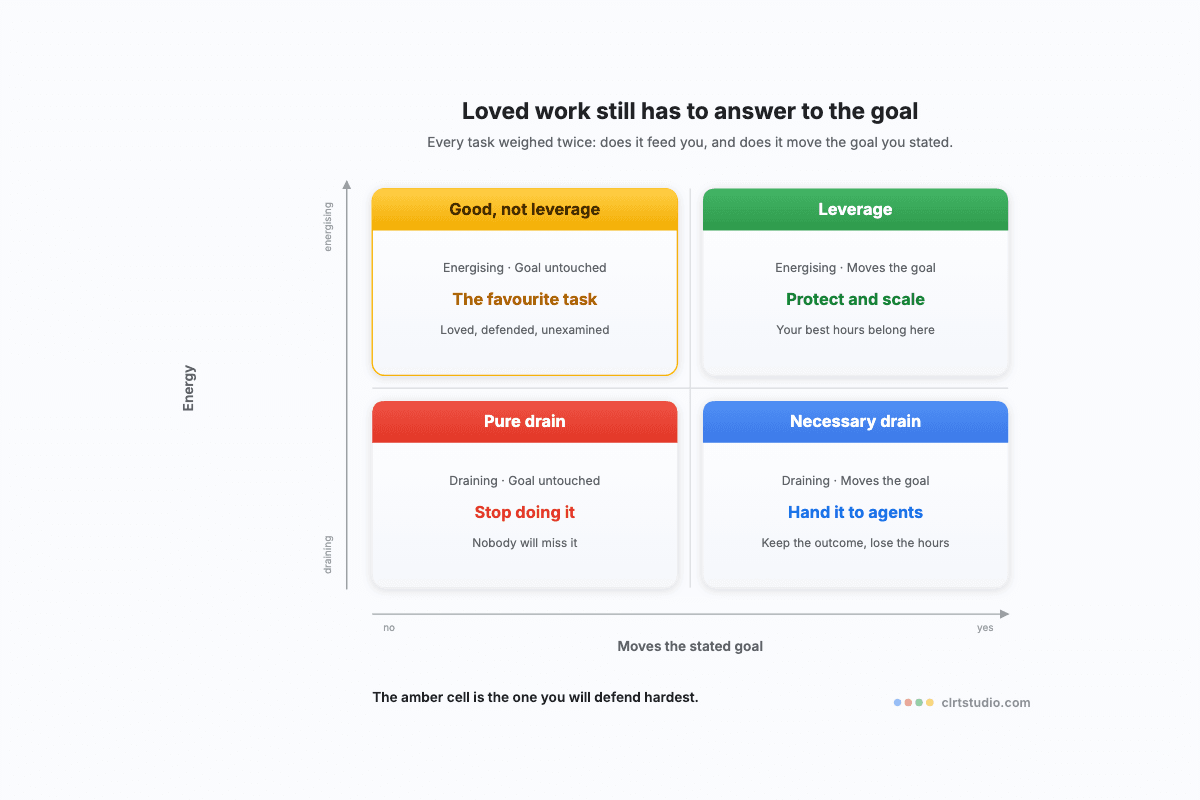
Two things most people assume travel together actually do not: being good at something, and being energised by it. Pull them apart, plot them as separate axes, and you get a map of where a person should truly spend their time. The corner where both run high is their Zone of Genius, and almost nobody spends enough of their life inside it.
The horizontal axis is skill, how good you are relative to a real benchmark. The vertical axis is love, how much the work feeds you rather than drains you. They are independent, and that independence is the whole insight. It produces four zones. Low skill and low love is drudgery. Low skill and high love is passion that has not yet found its craft. High skill and high love is the Zone of Genius. And high skill with low love is the dangerous one, the competence that quietly empties you, dangerous precisely because you are good at it, so you keep being handed it and keep saying yes.
The target is to spend roughly 80 percent of your time in your Zone of Genius. Below that line, your most valuable capacity is being leaked into work that does not compound. And here is where AI enters, not as a threat but as the obvious move. You identify the genius, then design agents to carry the other three zones, the drudgery first. Adoption stops being a fight, because you are taking away the work nobody wanted in the first place.
Being good at something is not a reason to keep doing it. The question is whether it is yours to do.
A deeper dive
The quadrant that does the real damage is high skill, low love, and it deserves close attention because it is the hardest to escape. People defend that work fiercely, because competence feels like obligation and because they are, genuinely, the best person available to do it. That is also why it carries the highest return on delegation and meets the most resistance, a combination that makes it the central problem of the whole framework. The 80 percent threshold is not a vanity figure. Below it, the highest-value person in a business spends too much of their finite capacity outside their leverage to let anything compound, so the number is a target for reallocation, not a badge. And the change-management consequence is the quiet masterstroke: leading AI adoption with "let us take your drudgery" rather than "let us make you redundant" inverts the resistance entirely, which is why the genius map belongs at the very front of any adoption effort.
Key terms
- Drudgery
- Low skill and low love.
- Unfound craft
- Low skill and high love, passion that has not yet found its craft.
- Zone of Genius
- High skill and high love.
- Dangerous competence
- High skill and low love, the work that quietly empties you.
Work with CLRT
Your Zone of Genius is only useful once it is measured against what you are actually trying to achieve. That is what CLRT Ascent does, and it quantifies the drain in dirhams. Map yours.

Vishal Sachar
Vishal Sachar is the Co-Founder and CEO of CLRT, where he helps UAE businesses make sense of applied agentic AI and put it to work. He writes on agentic systems, AI governance, and the economics of automation. Reach him at vishal@clrtstudio.com or on LinkedIn.