What Is an AI Agent, Really?

Vishal Sachar
Co-Founder & CEO of CLRT
An AI agent is software that pursues a goal through a loop of decisions and actions. That is the whole idea. It is not a chatbot with a confident personality, and the difference is the reason most people misjudge what these systems can do.
A chatbot answers. You ask, it replies, and the exchange ends there. An agent is given an objective and then works toward it across many steps, choosing what to do next, using tools to do it, looking at the result, and deciding whether it is finished. The conversation is no longer the product. The completed task is.
Picture the difference with a simple errand. A chatbot is the colleague who, when asked about a late invoice, tells you how invoice chasing usually works. An agent is the colleague who looks up which invoices are overdue, drafts the reminders, sends the ones it is allowed to send, flags the awkward ones for you, and tells you at the end what it did. One explains the task. The other does it.
The mechanism that makes this possible is the loop. The agent perceives the current state, decides on an action, takes it using a tool such as a database, an email system, or a web search, then checks the outcome and repeats. It keeps going until the goal is met or until it hits something it is not permitted to handle alone. That loop, running on its own, is what people mean when they say agentic.
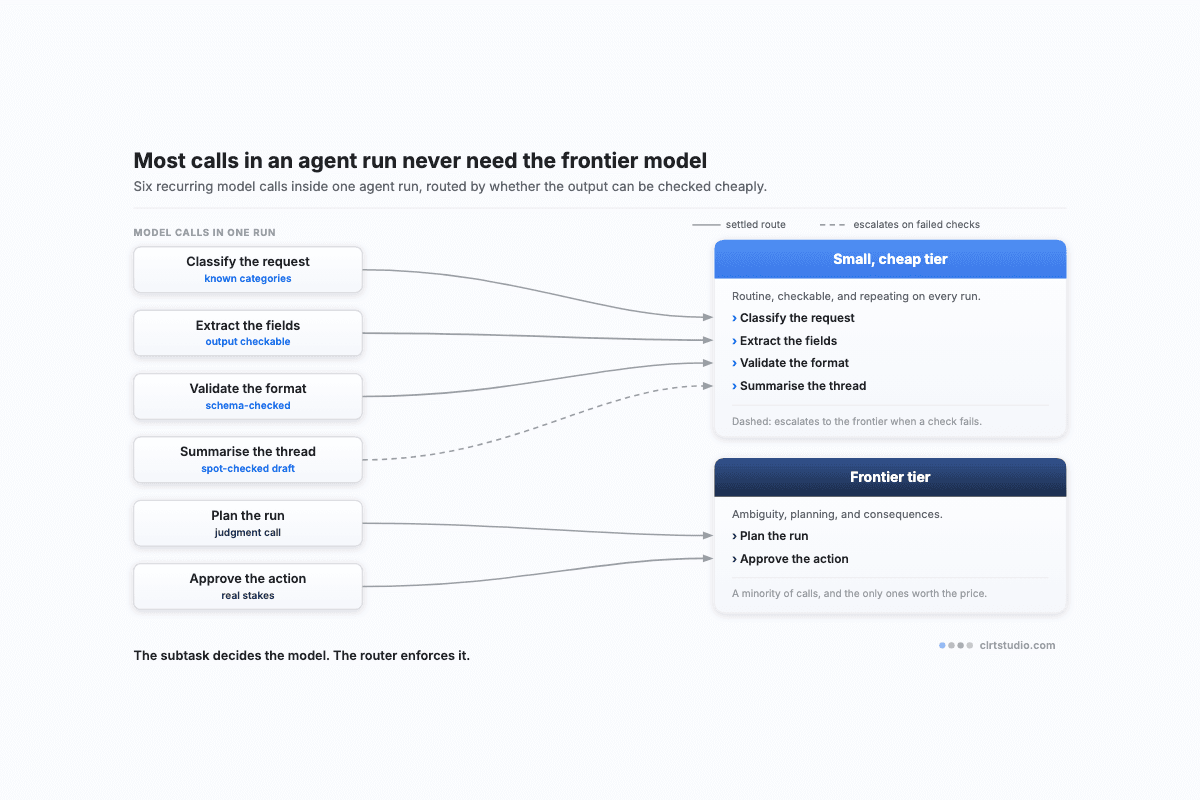
This is why the right question is never "how clever is the model." It is "what is the agent allowed to do, what tools can it reach, and who checks its work." A modest model inside a well-designed loop will outperform a brilliant one answering questions in a box.
An agent is not a smarter chatbot. It is a worker you delegate to. Everything interesting about this technology follows from taking that sentence seriously.
A deeper dive
The loop has a name in the literature, the reason-and-act pattern, and its mechanics are simple enough to hold in your head. At each step the model is given the goal, a record of what it has done so far, and a list of tools it is allowed to call. It produces a short piece of reasoning and then either calls a tool or declares the goal met. The tool runs, its result is appended to the record, and the loop turns again. Two design choices, not the model, decide how capable the agent is. The first is the tool set: an agent can only act on the world it can reach, so giving it the right database, API, or search is what expands its power. The second is the stopping condition: a loose one lets it wander and burn tokens, a tight and verifiable one ("stop when these specific checks pass") makes it reliable. This is why two teams using the identical model get wildly different results. They are not buying different intelligence. They are building different loops around it.
The sequence
- 01
Perceive
Read the current state.
- 02
Decide
Choose the next action.
- 03
Act
Take it using a tool such as a database, an email system, or a web search.
- 04
Check
Look at the outcome and decide whether the goal is met.
Work with CLRT
Want your team to actually build with this rather than just read about it? Hands-on agent building is the core of CLRT's founder workshops, written for non-technical operators.

Vishal Sachar
Vishal Sachar is the Co-Founder and CEO of CLRT, where he helps UAE businesses make sense of applied agentic AI and put it to work. He writes on agentic systems, AI governance, and the economics of automation. Reach him at vishal@clrtstudio.com or on LinkedIn.